
Why ‘Recession Headlines’ Sell Subscriptions: A Forensic Look at Media Incentives
Financial media wants you to believe it is a public utility: a neutral pipeline delivering truth from “the economy” to “the investor.” That’s branding. In practice, it’s an attention business with a compliance layer: the editorial voice exists to keep you paying, keep you refreshing, and keep you emotionally activated.
As of February 28, 2026, the macro picture is what it has been for years: complex, non-linear, and regime-dependent. Some indicators look late-cycle; others look like a soft landing; still others look like a rolling slowdown that never quite arrives on schedule. That ambiguity should produce careful language and probability distributions. Instead, major outlets saturate the feed with “recession” terminology—recession watch, recession risk, recession odds, recession warning, recession trade, recession playbook.
This is not objective reporting. It’s a subscription drive wearing a tie.
Here’s the thesis, stated without moral cosmetics: when fear is profit, truth is an overhead cost the media cannot afford. “Recession fear mongering” is not a bug; it’s a product feature in the subscription economy news model. The incentives are aligned toward anxiety, not accuracy. And the market—cold, mathematical, amoral—rewards that alignment through financial news stock performance and valuation multiples that quietly embed a “volatility premium.”
If you want media skepticism, stop reading headlines as information. Start auditing them as incentive structures.
The Attention Economy’s Dark Secret: Clickbait Economics

The economics are simple enough to be embarrassing.
This is clickbait economics: the optimization of editorial packaging for behavioral capture rather than informational value. The media industrial complex doesn’t need you informed. It needs you activated. Fear is the most reliable activation mechanism because it short-circuits deliberation and increases frequency.
And frequency is the whole game. A subscription business is not built on your one-time respect; it’s built on your repeated anxiety. The “recession” narrative is particularly lucrative because it is:
- Evergreen (it can always be framed as “approaching”).
- Non-falsifiable in the short run (you can always say “the effects are lagged”).
- Elastic (any weak datapoint becomes “confirmation,” any strong datapoint becomes “the last gasp”).
- Emotionally symmetric (both bulls and bears will click: bulls to defend, bears to gloat).
This is why recession language proliferates even when the data is mixed. Mixed data is not a barrier; it’s raw material. Ambiguity is monetizable because it can be packaged into urgency.
Skeptic’s Sidebar: “A well-informed public is a terrible customer for a 24-hour news network. An anxious public, however, will pay any monthly fee to be told what to fear next.”
The “dark secret” is that the newsroom is not primarily competing on truth. It’s competing on engagement yield per unit of content. A recession headline is a high-yield instrument: it increases time-on-site, repeat visits, and conversion probability. It also creates a psychological debt: once you accept the premise that danger is imminent, you feel compelled to keep paying to monitor the danger.
That’s not journalism. That’s a treadmill with a paywall.
This is where media profit models meet cognitive exploitation. If you want a neutral explanation, take it from behavioral finance: humans overweight negative outcomes, seek certainty under stress, and confuse narrative coherence with predictive power. Financial outlets industrialize those biases.
Data Deep-Dive: Correlating the Fear Index with Media Stocks
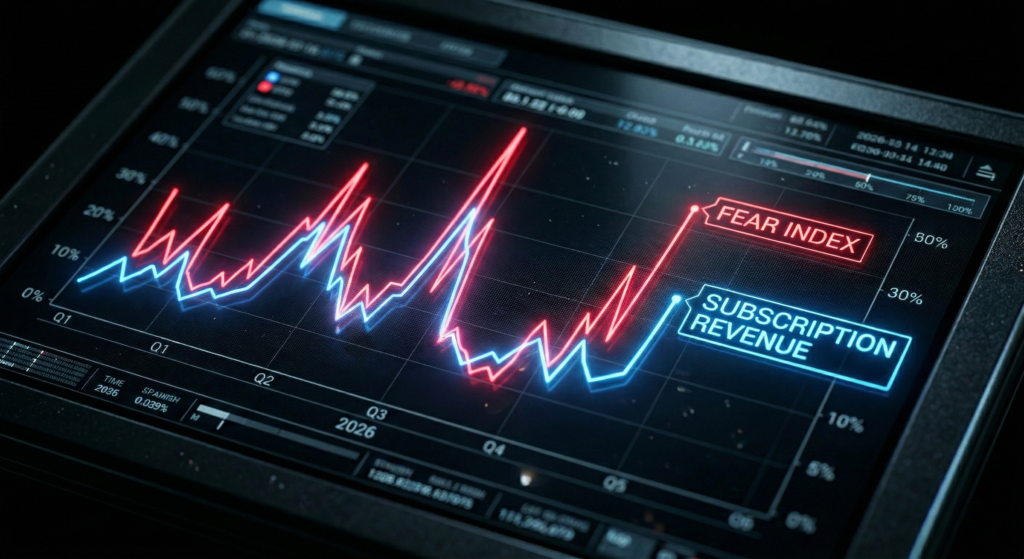
The cleanest way to understand the system is to treat “fear” as an input and “media revenue/valuation” as an output. The market already does this implicitly.
Volatility is not merely a market condition; it is a demand shock for financial content. When investors feel uncertain, they seek interpretation. When they seek interpretation, they pay for it. When they pay for it, subscription businesses get repriced.
This is fear index news as a revenue catalyst.
The Forensic Audit Logic (Not a “Hot Take”)
You don’t need perfect causality to see the incentive structure. You need directional relationships and timing:
- VIX spikes → market participants experience uncertainty and loss aversion.
- Uncertainty rises → demand for “explanations” rises.
- Demand for explanations rises → traffic and engagement rise.
- Engagement rises → ad inventory clears at better rates; newsletter funnels convert better.
- Conversion improves → subscriber growth and retention improve.
- Recurring revenue improves → valuation multiple expands.
- Result: better financial news stock performance relative to calmer periods.
This is the “Volatility Premium” in media: a structural tendency for financial news businesses to benefit from macro stress. Not because they predict it—prediction is hard and expensive—but because they package it.
The Valuation Mechanism: Fear Monetization Becomes a Multiple
A subscription company’s valuation is a function of expected cash flows discounted by risk, but also of perceived durability:
Fear increases all three. That’s the uncomfortable link between recession chatter and media company valuations: fear is not only monetized as revenue; it is monetized as investor confidence in the media business model.
This is why “recession fear mongering” persists even when it degrades trust. Trust is a long-duration asset. Subscriptions are short-duration cash flows. Public companies optimize for the latter because quarterly reporting turns patience into a career risk.
The Playbook: Economic Data Manipulation
“Manipulation” here doesn’t mean forging numbers. It means selecting, framing, and sequencing data to sustain a profitable narrative. Call it editorial arbitrage.
In 2026, the macro environment is a buffet of contradictory signals. That makes it easy to manufacture certainty by selective emphasis. The playbook is stable across outlets because the incentives are stable across outlets.

Tactic 1: Cherry-Picking Lagging Indicators
Lagging indicators are a content goldmine because they can be used to claim inevitability. If something worsens after a slowdown begins, it’s presented as “proof the recession is here.” If it hasn’t worsened yet, it’s presented as “proof the recession is coming.” Either way, the narrative survives. Hard truth: Lagging indicators are not forecasts; they are confirmations. But confirmations are emotionally satisfying and therefore commercially useful.
Tactic 2: One Datapoint Becomes “The Economy”
A single weak print—manufacturing, housing, sentiment—becomes “the economy flashing red.” The next day, a strong print becomes “distorted,” “seasonal,” or “the last sugar high.” This is economic data manipulation via asymmetrical skepticism: good news is interrogated; bad news is amplified.
Tactic 3: Denominator Games
A 0.3% miss becomes “shocking” because the headline omits the distribution of outcomes and historical error bands. A “rise” in layoffs becomes panic fuel without specifying whether the level is low, normal, or high relative to the labor force. If you want to catch manipulation, look for missing denominators and missing baselines. Any chart without a long time axis is a sales brochure.
Tactic 4: Probability Laundering
“Economists say recession risk is rising” is a laundering mechanism. It converts a probabilistic statement into a narrative inevitability. If the recession doesn’t happen, the outlet doesn’t repay the fear premium it charged you in attention and subscription fees. The business keeps the revenue; you keep the stress.
Tactic 5: Adjective Inflation
When the data is ambiguous, adjectives do the heavy lifting: “ominous,” “grim,” “stunning,” “alarm bells.” Adjectives are not analysis; they are conversion optimization. They exist because the model is paid on arousal, not calibration.
The Cost to the Investor: The ‘Panic Premium’

The media doesn’t just monetize fear directly. It also imposes a hidden tax on decision-making: the Panic Premium.
This is the spread between what a rational investor would do with raw data and what a stimulated investor does after consuming a steady diet of recession content. Mechanically, it looks like this:
- Headline induces urgency: “recession incoming.”
- Investor experiences loss aversion and seeks immediate action to reduce discomfort.
- Action becomes trading: selling risk assets, hoarding cash, chasing “safe” narratives.
- Investor locks in losses or misses rebounds.
- Investor returns to media for explanation and reassurance.
- Media sells more reassurance—often by selling more fear.
The hard truth is ugly: financial media can be economically correct in the long run and still financially destructive to you in the short run because it optimizes for your reaction, not your outcome.
Conclusion: The Unpaid Analyst Verdict
The recession headline wave of 2026 is not a public service announcement. It’s a marketing campaign embedded in editorial form. In the subscription economy news model, fear is the product, attention is the currency, and your stress is the conversion funnel.
This is why “recession fear mongering” persists: it is profitable, it is scalable, and it has weak accountability. The incentives are misaligned by design. Truth is expensive; fear is cheap. In a market where engagement drives valuation, you get fear.
Actionable Advice: The 5-Minute Input Audit
To survive as a sovereign investor, you must actively protect your attention. Here is your actionable advice, stripped of therapy language:
- Audit the Adjectives: Read a headline and strip away every emotional word (“Plunge,” “Shock,” “Dire,” “Chaos”). If the remaining facts are boring, ignore the article.
- Follow the Primary Source: If a news outlet cites a “Labor Report,” go to the Bureau of Labor Statistics website and read the raw PDF. You’ll find that the “shocking” news is often a standard 0.1% variance.
- Check the Stock: If you see a major “Crisis” narrative, check the stock price of the media company reporting it. Are they beating earnings? Is their subscription revenue up? If so, you are the product being harvested.
- Opt-Out: Turn off push notifications. Information should be sought, not pushed. Stop paying the “Panic Tax.”
The final forensic point is the simplest: the news is not designed to make you a better investor. It’s designed to make you a more frequent subscriber. If you refuse to pay with money, you’ll pay with attention. If you refuse to pay with attention, they’ll try to make you pay with anxiety.
That’s the business. That’s the incentive. And it’s why the recession headlines keep coming—whether the recession does or not.
SYSTEM STATUS: ANALYST PROFILE
The Unpaid Analyst: Zero Agenda, Raw Data. Most analysts are paid to tell you exactly what you want to hear. I’m not. On this site, mainstream narratives are dismantled using cold math and the hard facts that the media ignores to keep the public comfortable. I don’t peddle dreams or “get-rich-quick” schemes. I deliver raw macroeconomic reality—because the truth doesn’t need a sponsor.