
The ‘Automatic’ Dropshipping Trap: A Forensic Audit of a Losing Game

If you scroll through TikTok or YouTube in February 2026, the pitch hasn’t changed since 2018: “Find a winning product, run some ads, and let the software handle the rest.” They call it the ultimate automated dropshipping business reality.
I call it unprotected arbitrage
Modern dropshipping is not a business model. It is a financial instrument where you accept 100% of the operational risk (returns, bans, ad spend) in exchange for 5% of the margin—if you’re lucky. You don’t control manufacturing, you don’t control fulfillment, you don’t control product quality, and you don’t control traffic. You control a Shopify theme and a prayer.
The “laptop lifestyle” sold to you isn’t an opportunity; it is a predatory marketing funnel designed to transfer wealth from desperate beginners to platform owners like Shopify, Meta, and the gurus selling you the course. We previously audited this predatory ecosystem in our breakdown of the $5,000 Guru Tax, where we showed how the “educator” is often the only one making a profit.
We need to strip away the viral screenshots of “Gross Revenue” and look at the only number that pays the rent: Net Profit. As we discussed in our analysis of the passive income delusion, marketing hype thrives by hiding the unpaid labor and financial leakage required to keep the system running.
The Forensic P&L: Revenue is Vanity, Profit is Sanity
The most expensive lie in e-commerce is the screenshot of gross sales with confetti animations.
Revenue is not performance. Revenue is top-line throughput—a measure of how much money you handled, not how much you kept. In a low-margin, high-refund environment, revenue can be a symptom of failure: it often means you successfully bought a large number of unprofitable customers.
Novices calculate profit like this:
$$ \text{Retail Price} – \text{Wholesale Cost} = \text{Profit} $$
Forensic analysts calculate profit like this:
$$ \begin{aligned} \text{Retail Price} – (&\text{COGS} + \text{CAC} + \text{Merchant Fees} + \text{Software Stack} + \text{Return Rate} \\ &+ \text{Chargeback Ratio}) = \text{Net Reality}\end{aligned} $$
Skeptic’s Sidebar:
“If your business model relies on finding customers cheaper than Meta wants to sell them to you, and sourcing products cheaper than Alibaba wants to sell them to everyone else, you don’t have a business. You have a temporary arbitrage window that is rapidly closing.”
Data Deep-Dive (The Guru Promise vs. The 2026 Reality)
Influencers sell a simplified equation:
$$ \text{Sale price} – \text{product cost} = \text{profit} $$
That’s not an equation. That’s a crime scene with the body removed.
In 2026, the real cost of dropshipping ads has exploded. With privacy changes locking down targeting on Meta and TikTok, the “Customer Acquisition Cost” (CAC) has risen to levels that make low-margin arbitrage mathematically impossible.
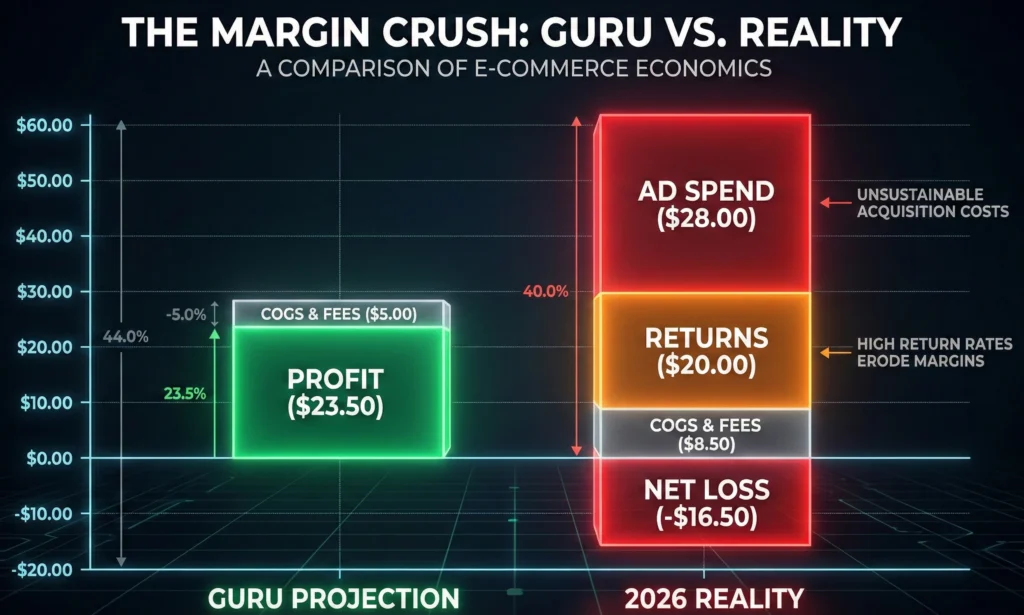
Below is a unit economic model for a standard “viral” product sold for $50.00.
The $50 Product Unit Audit
|
Line Item |
The Guru Projection (Ideal) |
The Unpaid Analyst Audit (Reality) |
|---|---|---|
|
Retail Price |
$50.00 |
$50.00 |
|
Cost of Goods Sold (COGS) |
-$15.00 |
-$15.00 |
|
Gross Margin |
$35.00 (70%) |
$35.00 (70%) |
|
Ad Spend (CPA) |
-$10.00 (Fantasy ROAS of 5.0) |
-$28.00 (Realistic ROAS of 1.8) |
|
Transaction Fees (3%) |
-$1.50 |
-$1.50 |
|
Shopify Apps/Email |
-$0.00 (Ignored) |
-$2.00 (Amortized per unit) |
|
Return Rate Impact (40%) |
$0.00 |
-$20.00 (Refund + Lost Shipping) |
|
NET PROFIT / LOSS |
+$23.50 |
-$16.50 |
The Analysis:
Look at the Unpaid Analyst Audit. The “Guru” tells you that a $15 product sold for $50 prints money. But in 2026, you are paying Meta/TikTok the majority of your margin just to get the click.
Then comes the killer: Returns. If you sell a generic gadget and 4 out of 10 people return it (a common high return rate ecommerce statistic), your unit economics collapse. You paid for the ad, you paid for shipping, and you refunded the customer. You paid three times to lose money once.
This is the automated dropshipping business reality: You don’t have a margin problem. You have a structure problem.
The Silent Killers: 40% Returns and Ad Fatigue
The “passive” myth relies on the idea that once a store is set up, it runs itself. This ignores the operational violence of the Shopify P&L analysis.
1. The 40% Return Rate
Credible industry data suggests that while standard e-commerce return rates hover around 20-30%, dropshipping niches often push 40%.
2. Ad Fatigue & The Content Treadmill
To maintain that “automated” income, you must feed the algorithm fresh content daily. Ad creatives that worked in January burn out by February. You are effectively renting attention from platforms you don’t own.
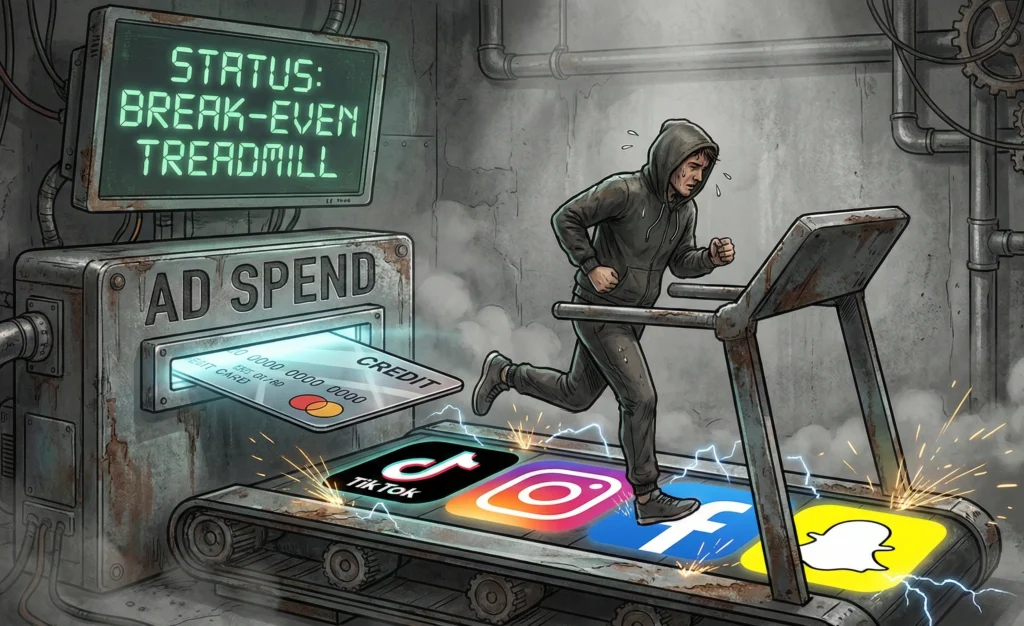
This connects directly to the warning signs we listed in Get-Rich-Quick Scheme Red Flags: any system that relies on “secret” loopholes or temporary platform arbitrage is destined to collapse. You aren’t a CEO; you are a freelance content creator for TikTok who pays for their own distribution. This isn’t passive income; it’s a treadmill with a payment processor attached.
The Final Verdict: You Are Unpaid Logistics Support
Let’s strip the romance out of it. What do you actually own?
You are effectively working as unpaid logistics support for a factory in Shenzhen and a data entry clerk for Mark Zuckerberg. You take the risk. They take the equity.
Here’s the clean takeaway from this dropshipping profit margins audit: in 2026, the real cost of dropshipping ads plus high return rate ecommerce dynamics turns “easy money” into negative expected value.
The market isn’t “harder.” It’s more efficient. The free lunch got priced in, competed away, and then taxed by privacy changes and consumer skepticism. The only people still selling the “automatic” narrative are the ones who don’t have to reconcile refunds, chargebacks, and ad invoices—because they monetize you, not the store.
Here’s the clean takeaway from this dropshipping profit margins audit and Shopify P&L analysis: in 2026, the real cost of dropshipping ads 2026 plus high return rate ecommerce dynamics turns “easy money” into negative expected value for most entrants.
The market isn’t “harder.” It’s more efficient. The free lunch got priced in, competed away, and then taxed by privacy changes and consumer skepticism. The only people still selling the “automatic” narrative are the ones who don’t have to reconcile refunds, chargebacks, and ad invoices—because they monetize you, not the store.
Actionable Advice:
- Stop chasing push-button income. If it were real, it wouldn’t be sold in a course funnel.
- Run a fully loaded P&L. Model CPA, fees, and a realistic return rate. If you can’t survive those assumptions, you don’t have a business—you have a gambling habit with better UI.
- If you want e-commerce, own something defensible:
- Own the product (unique SKU, real differentiation),
- Own the brand (repeat purchase behavior, trust, community that isn’t rented), or
- Own the distribution (email/SMS with real retention, SEO, partnerships).
If your plan requires perfect attribution, cheap clicks, low returns, and endless customer patience, then your plan is not a plan. It’s nostalgia for 2018—sold at 2026 prices.
Sources & Data Context (2026 Audit)
SYSTEM STATUS: ANALYST PROFILE
The Unpaid Analyst: Zero Agenda, Raw Data. Most analysts are paid to tell you exactly what you want to hear. I’m not. On this site, mainstream narratives are dismantled using cold math and the hard facts that the media ignores to keep the public comfortable. I don’t peddle dreams or “get-rich-quick” schemes. I deliver raw macroeconomic reality—because the truth doesn’t need a sponsor.